


As global leaders prepare to convene for COP30 in Brazil, a new report highlights a dire and often overlooked crisis: the survival of the world’s remaining uncontacted Indigenous peoples. Survival International, an international NGO dedicated to defending Indigenous rights, published its latest study on Monday, revealing that 196 uncontacted Indigenous groups across South America, Asia, and the Pacific face imminent threats to their very existence. The report, titled Uncontacted Peoples: At the Edge of Survival, draws on five years of field research and extensive data collection.
According to the study, roughly half of these groups—comprising tens of thousands of people—could disappear within the next decade. Industrial encroachment, organized crime, and missionary interventions are cited as the leading causes, with logging, mining, and large-scale agribusiness operations posing the most immediate dangers. Even indirect contact with outsiders, which can spread deadly diseases, represents a potentially catastrophic risk to these populations. Climate change and illegal resource extraction only add to their vulnerability.
In South America alone, more than 60 confirmed isolated groups reside in the Amazon basin, with dozens more reported. Most of these confirmed populations—about 90 percent—are found in Brazil and Peru, placing the survival of these tribes directly in the hands of these two nations’ policies and enforcement.

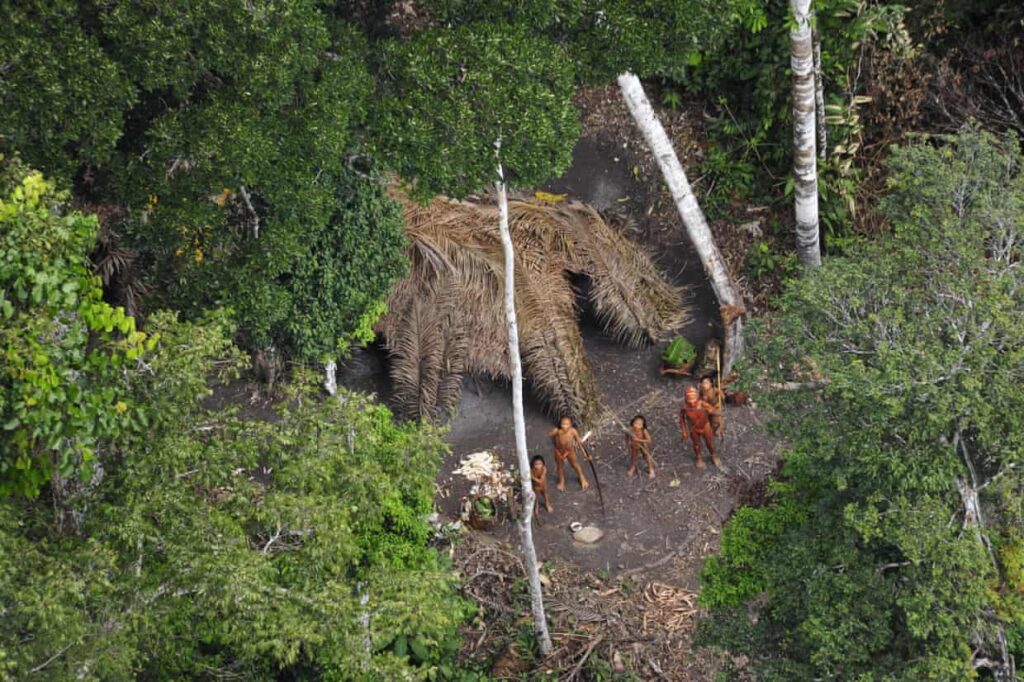
For decades, Brazil has recognized the importance of protecting isolated Indigenous peoples. In 1987, the country adopted a policy mandating the demarcation of Indigenous territories while strictly limiting contact unless initiated by the communities themselves. This framework has historically allowed populations to grow and flourish, and has contributed to the increased identification of distinct peoples over the years.
However, in recent decades, the agency charged with protecting these populations—the National Foundation for Indigenous Peoples (Funai)—has been systematically weakened. Its patrolling authority has never been fully formalized. While President Luiz Inácio Lula da Silva issued a decree last year to strengthen Funai, subsequent legislative attempts have partially undermined these efforts. Chronic underfunding and understaffing have left the agency’s field infrastructure in disrepair, and qualified personnel have not been recruited to manage these highly sensitive missions.
Recent legal developments have further jeopardized the security of isolated communities. In 2023, Brazil’s Congress passed the so-called “marco temporal” law, which recognizes only Indigenous territories occupied by aboriginal peoples as of October 5, 1988—the date the Brazilian Constitution was enacted. While this law theoretically excludes areas such as the Pardo River Kawahiva, where isolated groups were first officially recorded in 1999, these peoples have lived in the region for generations. The law has nonetheless been wielded as a political tool to block the demarcation of Indigenous lands, leaving communities vulnerable to illegal exploitation and violence. Of Brazil’s 114 reported isolated groups, only 28 have been officially confirmed. Many remain in undemarcated areas, or in territories at risk of elimination if the marco temporal principle is fully applied.
The current political push to weaken environmental protections compounds these threats. Efforts to open protected areas and Indigenous lands to logging, gold mining, and agribusiness operations endanger the survival of countless uncontacted tribes. For isolated peoples, incursions by resource extractors are often a death sentence.
Peru faces similar challenges. Disinformation campaigns, often driven by parties with economic interests in the rainforest, deny the existence of uncontacted communities, despite official government recognition of 25 separate groups. Indigenous organizations suggest that at least 10 additional groups remain undocumented. Denial of these communities’ existence effectively constitutes a campaign of extermination, a danger amplified by proposed legislation that would erode Indigenous territorial protections.
Two recent bills, 12215/2025-CR and 11822/2024-CR, exemplify the threat. The first bill would allow Congress and a “special review committee” oversight of Indigenous reserves, potentially eliminating existing lands and making new designations nearly impossible. The second bill would permit oil and gas extraction in all natural protected areas, including national parks, some of which are inhabited by isolated peoples. Government records acknowledge the presence of uncontacted communities in 13 protected areas, although evidence suggests they inhabit at least 18. Oil and gas development in these lands could result in the extinction of entire populations.
Even absent new legislation, the survival of isolated peoples in Peru is precarious. On September 4, the “multisectoral committee” responsible for establishing reserves for uncontacted communities rejected the proposal for the 1.2-million-hectare Yavari Mirim Indigenous reserve, despite official recognition of the community by the Peruvian government in 2018. Members of the committee from the Ministry of Agriculture, Forest Service, and regional government of Loreto voted as a bloc against the reserve, ignoring decades of evidence documenting the traditional territories of these communities. The Ministry of Environment, which has received substantial international funding for forest protection, abstained from the meeting, further undermining the reserve’s establishment.
The commission has also failed to finalize the expansion of the Madre de Dios territorial reserve, leaving the Mashco Piro peoples exposed to illegal logging activities. Some of these logging operations have even received sustainability certification from the Forest Stewardship Council, highlighting the limits of such designations in protecting Indigenous populations.
As COP30 host, Brazil has urged the international community to take ambitious climate action. Both Brazil and Peru accept hundreds of millions of dollars in international funding to combat deforestation and climate change, including through Brazil’s Amazon Fund and contributions from Germany, Norway, and the UK under the Joint Declaration of Intent. Yet these governments simultaneously allow the destruction of forests that hold enormous carbon stocks, harbor immense biodiversity, and provide the only habitat for some of the planet’s most vulnerable human populations.
Indigenous peoples themselves have resisted these pressures because, for them, the forests are life itself. Many have lost their lives in the struggle, yet their communities continue to fight for survival. Julio Cusurichi Palacios, director of the program for the defense of isolated Indigenous peoples for the Interethnic Association for the Development of the Peruvian Rainforest (AIDESEP), calls on both the Brazilian and Peruvian governments to stop “playing both sides” and to fulfill their constitutional, legal, and moral obligations to protect Indigenous territories and the people who simply wish to live free.
Survival International’s report underscores a fundamental truth: protecting isolated Indigenous peoples is inseparable from protecting the forests they inhabit. These communities maintain ecosystems that are crucial not only to their survival but also to the global fight against climate change. Their right to remain uncontacted and maintain their traditional ways of life is a matter of both human rights and environmental security.
Yet, without immediate action, these isolated peoples face extinction within a generation. Governments must strengthen protections, demarcate territories, and enforce laws that prevent encroachment. International partners providing climate funding must ensure that their investments actually preserve the forests and respect the Indigenous communities that sustain them. The world cannot afford to lose these peoples or their lands—the consequences for both biodiversity and climate stability would be catastrophic.
COP30 presents a unique opportunity for Brazil, Peru, and the international community to align climate goals with the protection of human rights. The survival of isolated Indigenous peoples, their cultures, and the forests they call home depends on decisive action. The message from these communities is clear: leave us alone to live freely, and defend our forests as a vital part of the planet’s future.
For those who advocate for climate and human rights, there is no time to waste. The choices made today will determine whether these peoples survive the coming decades or disappear forever from the world stage.