


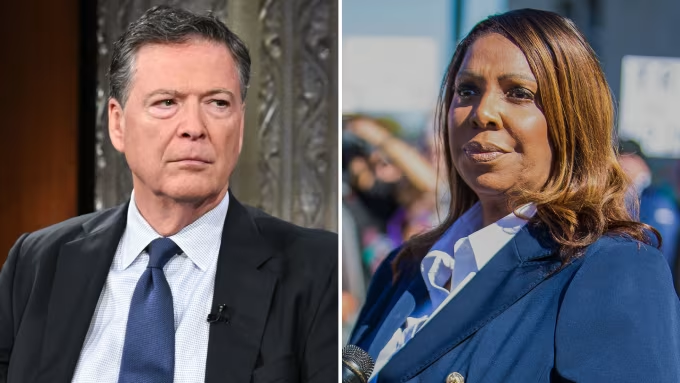
A federal judge on Monday threw out the criminal cases former President Donald Trump pushed against two of his highest-profile adversaries — former FBI Director James Comey and New York Attorney General Letitia James — marking an early blow to Trump’s pledge to seek retribution against political opponents.
U.S. District Judge Cameron McGowan Currie ruled that the indictments were invalid because the prosecutor leading them, interim U.S. attorney Lindsey Halligan, was unlawfully installed. Halligan was appointed only after Trump and Attorney General Pam Bondi forced out the sitting U.S. attorney who had declined to bring the charges.
The decision not only halts the first major prosecutions in Trump’s revenge drive, at least temporarily, but also bolsters concerns that the cases were rushed, politically motivated, and carried out with little regard for standard legal procedures.
Judge Cites Lack of Legal Authority to Appoint Prosecutor
In both rulings, Judge Currie emphasized Halligan’s lack of experience and the Justice Department’s irregular steps to position her to pursue the cases.
Currie noted that Halligan had “no prior prosecutorial experience” and sharply criticized Bondi’s attempt to retroactively redefine Halligan’s status. According to the ruling, the Justice Department “identified no authority allowing the Attorney General to reach back in time and rewrite the terms of a past appointment.”
The judge’s opinion indicated that the cases could have collapsed for multiple reasons, but the unlawful appointment was the most clear-cut, requiring that every action taken under Halligan’s authority be voided.
Ironically, Currie cited language from Judge Aileen Cannon’s ruling this year dismissing Trump’s classified documents case, which also relied on arguments over unlawful appointments.
Legal Missteps Add to Political Liability
Investigators and judges had already raised red flags before Monday’s decision. Last week, a magistrate judge accused Halligan and the Justice Department of a “disturbing pattern of profound investigative missteps,” including possible misuse of privileged material before a grand jury and questions over whether the final indictment was even presented to the full panel.
Even conservative legal analysts had warned that the Comey and James cases were vulnerable because of Halligan’s appointment.
Meanwhile, most Americans appear unconvinced that these prosecutions were legitimate. A recent Marquette Law School poll found voters believe the cases against Trump’s political opponents were unjustified by a 16-point margin, even as most said Trump’s own indictments were warranted.
What’s Next for Trump’s Retaliation Drive?
Because the cases were dismissed “without prejudice,” the administration could technically bring the charges again — but only if a legally appointed prosecutor signs them and a grand jury agrees.
The White House signaled plans to appeal, with press secretary Karoline Leavitt promising a challenge “very soon.” Still, significant hurdles remain:
The statute of limitations on the Comey charges expired September 30, meaning any attempt to refile would face immediate legal challenges.
A new U.S. attorney would likely require Senate approval, which could take months and face resistance from Virginia’s Democratic senators.
A previous grand jury narrowly approved the Comey indictment and even rejected one charge — a rare outcome that underscores the evidence’s weakness.
A Troubling Week for Trump’s DOJ
Monday’s ruling capped a string of high-profile stumbles for the Justice Department. Among them:
A Texas federal panel — led by a Trump-appointed judge — struck down a GOP-drawn electoral map, citing a questionable DOJ letter later disavowed by state officials.
Prosecutors abruptly dropped their case against a woman accused of ramming a Border Patrol agent over apparent investigative errors.
Federal investigators are now examining whether grand jury materials were improperly shared in probes targeting Letitia James and Sen. Adam Schiff.
Two federal rulings have challenged Trump’s authority over tariffs, a matter now before the Supreme Court.
With legal setbacks piling up and public skepticism growing, the administration now faces a pivotal decision: fight to revive the cases or retreat from a retribution effort that is proving far more difficult to execute than to promise.