


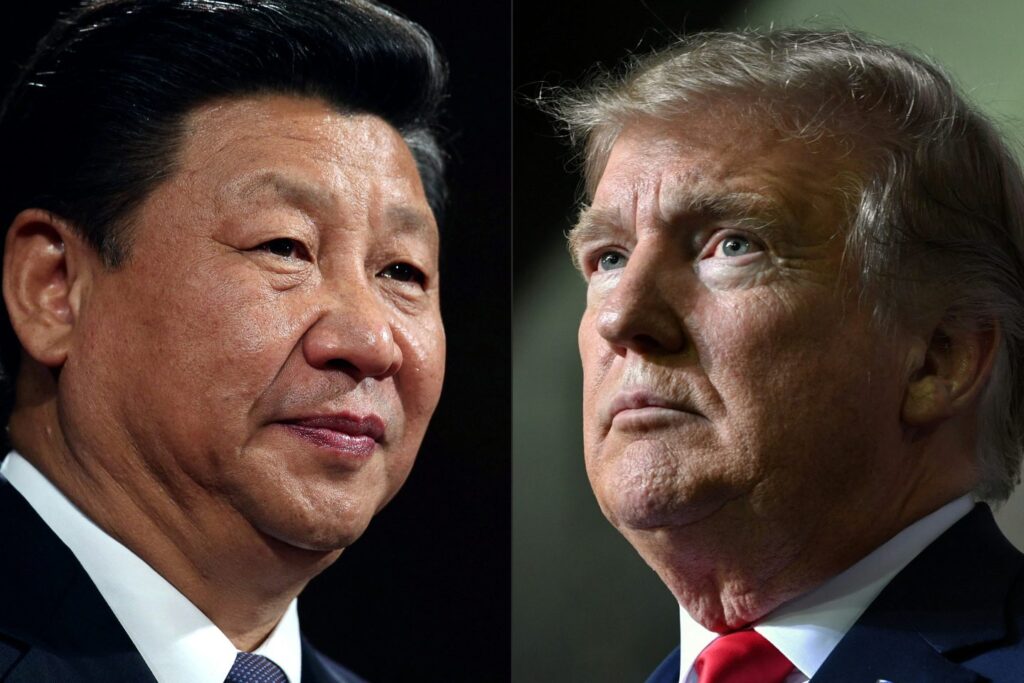
The Trump administration is projecting confidence as trade tensions with Beijing flare again, this time over China’s sweeping export controls on rare earth minerals. The move has sharpened concerns among U.S. officials and raised questions about how far Washington could go in response.
China dominates more than 90% of global processing of rare earths and rare earth magnets — key components used in defense systems, electric vehicles, smartphones and clean-energy technology. After Beijing imposed its latest restrictions, former President Donald Trump reacted by announcing a 100% tariff on Chinese imports and new software-related curbs.
In a stark social media post before unveiling those tariffs, Trump hinted at further actions. “The U.S. has Monopoly positions also — much stronger and more far reaching than China’s,” he wrote on Truth Social. “I have just not chosen to use them… UNTIL NOW!”
But in subsequent comments, Trump dialed back the threats and acknowledged the tariffs alone aren’t sustainable long term. On Wall Street, analysts largely dismissed the move as posturing aimed at negotiation leverage — and another chance for traders to cash in on the so-called “TACO” trade (Tariffs And China Oriented plays).
Despite the heated rhetoric, the White House says a planned meeting between Trump and Chinese President Xi Jinping is still expected to take place later this month on the sidelines of a regional economic summit in South Korea.
China’s rare earth policy initially rattled markets and analysts who warned that, in theory, it could “cripple any country’s participation in the modern global economy.” Yet a closer look suggests the restrictions may be narrower than early headlines implied.
According to Capital Economics, Beijing’s move appears designed as much to strengthen its bargaining position as to inflict harm. China may have been frustrated that Washington showed no sign of easing existing tariffs. Still, the firm’s China experts, Julian Evans-Pritchard and Leah Fahy, argued the strategy carries risks.
“Whatever the motivation, China’s recent actions were a bit of a gamble and there is a risk that they could backfire,” they wrote in a briefing published Monday.
They laid out several ways the U.S. could escalate in response — measures that would hit Beijing much harder than tariffs.
Control of Aviation Supply Chains
The U.S. remains a dominant force in commercial aerospace manufacturing. Washington could restrict the export of aircraft components — or even entire planes — to Chinese carriers and manufacturers, disrupting supply chains overnight.
Windows, Software, and Operating Systems
Roughly 90% of computers in China still run on Microsoft’s Windows operating system. Trump could move to suspend sales or block critical updates in China, exposing millions of devices to cybersecurity risks. While Chinese alternatives exist, the experience of Huawei’s forced tech pivot has shown how quickly global competitiveness can erode.
Even more sensitive is the software used in high-tech manufacturing. Western firms control over 70% of China’s chip-design software market — a choke point Beijing cannot easily replace.
Chips and Export Controls
Despite trying to build its own semiconductor ecosystem, China still depends on U.S. technology and manufacturing tools. Expanded export bans could cut deeper into China’s strategic industries, well beyond the current restrictions on advanced chips.
Financial Leverage and Sanctions
The United States also dominates global finance. Washington could freeze dollar-based assets of Chinese firms or block access to the SWIFT payment system, curbing Beijing’s ability to conduct international transactions.
Allied Pressure
Evans-Pritchard and Fahy note that the U.S. could coordinate with allies to pile on additional restrictions. Mexico has already floated tariffs of up to 50% on certain Chinese and Asian imports, signaling that Beijing may find fewer safe harbors abroad.
Capital Economics warned that hardliners on both sides could seize the moment to push deeper economic separation. “At best, we may return to the uneasy trade truce that had held up until now,” the firm said. “At worst, China may find itself cut off from Western markets and technology to an even greater degree than it is today.”
For now, both governments are positioning themselves ahead of the Trump–Xi meeting. The standoff over rare earths may only be an opening round in a larger contest over economic dominance.