


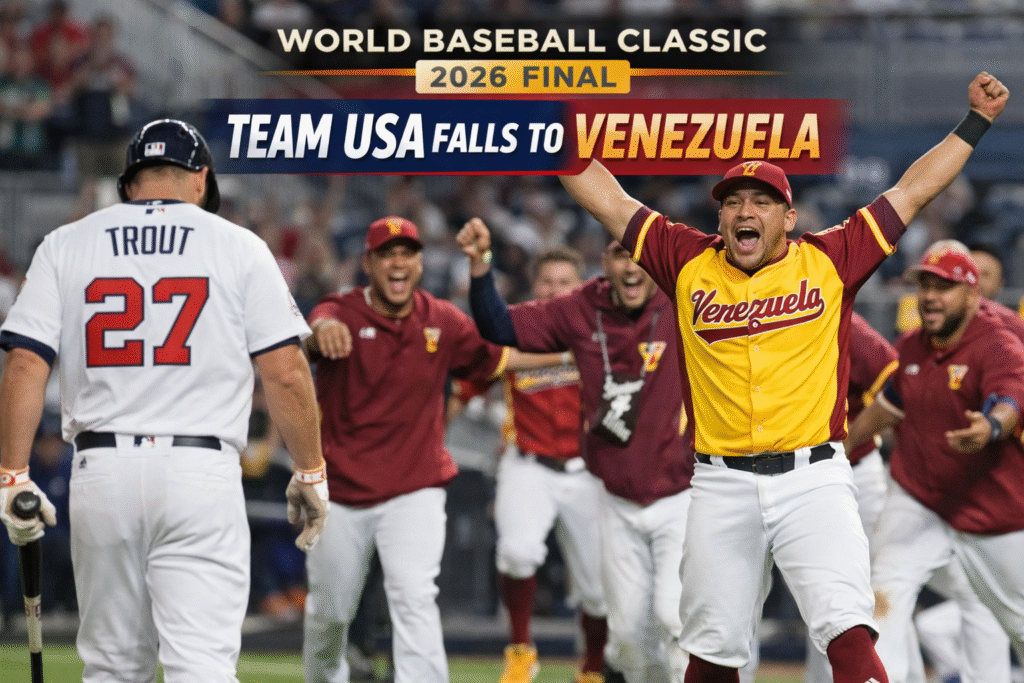
MIAMI — On paper, Team USA looked nearly unbeatable.
A lineup stacked with Major League Baseball stars, a pitching staff filled with proven arms, and the backing of a home crowd — everything pointed toward a championship finish in the World Baseball Classic. But baseball has a way of ignoring expectations, and in the end, the United States walked away without the title.
Instead, it was Venezuela that celebrated — not just a win, but a statement.
The final wasn’t decided by one moment or one mistake. It was a combination of missed opportunities, stalled momentum and a Venezuelan team that played with precision and purpose from the first pitch to the last.
A Slow Start That Set the Tone
From the opening innings, Team USA struggled to establish any offensive rhythm. The at-bats lacked consistency, and while there were occasional flashes of power, they rarely came at the right time.
Hitters who had been productive earlier in the tournament suddenly found themselves chasing pitches, falling behind in counts and failing to capitalize with runners on base. The timing just wasn’t there — and against a disciplined Venezuelan pitching staff, that proved costly.
Venezuela, on the other hand, looked composed. Their pitchers attacked the strike zone early, mixed speeds effectively and forced the American lineup into uncomfortable situations.
Missed Opportunities at the Plate
If there was one theme that defined Team USA’s performance, it was missed chances.
Runners were left stranded. Key innings ended without damage. Situations that demanded a clutch hit instead resulted in strikeouts or routine outs.
Over the course of the game — and even in the games leading up to the final — the offense never fully clicked. In a tournament where momentum is everything, that inconsistency became a major weakness.
By contrast, Venezuela took advantage of its opportunities. They didn’t necessarily overwhelm with power, but they executed when it mattered. Timely hitting, smart baserunning and situational awareness allowed them to build and protect their lead.
The Energy Difference
Beyond the numbers, there was a noticeable difference in energy.
Venezuela played with visible intensity. Every play felt urgent, every out celebrated, every run meaningful. The players fed off each other and off the crowd, creating an atmosphere that felt more like a national moment than just another game.
Team USA, despite its talent, appeared more measured — almost cautious at times. The spark that had defined parts of their earlier run wasn’t as evident in the final.
That difference in emotion may not show up in a box score, but it can influence the outcome in close games.
Pitching Held, But Not Enough
To be fair, Team USA’s pitching wasn’t the primary issue.
There were solid performances on the mound, and for stretches, the game remained within reach. But without consistent run support, even strong pitching efforts can only do so much.
Venezuela managed to put together key innings, stringing together hits at the right moments. They didn’t need a blowout — just enough offense to stay ahead.
And once they had the lead, their pitching staff did the rest.
A Tournament That Meant More
The World Baseball Classic has grown significantly in recent years, and this game served as another reminder of its importance.
For countries like Venezuela, this isn’t just about baseball — it’s about pride, identity and representing something bigger than the game itself.
That emotion was evident in the celebration that followed the final out. Players embraced, some in tears, fully aware of what they had accomplished.
For Team USA, the WBC still carries weight, but it doesn’t always match the intensity seen from international teams. That gap — however small — can make a difference in high-pressure moments.
The Pressure of Expectations
With a roster full of All-Stars, Team USA entered the final with high expectations. Anything less than a win felt like a disappointment.
But sometimes, that pressure can work against a team.
Instead of playing freely, players may press — trying to do too much in key moments. A swing becomes tighter. A decision becomes rushed. And in a game built on timing and confidence, those small changes can have big consequences.
Venezuela, by comparison, played loose but focused. They had confidence, but not the same weight of expectation. That balance allowed them to stay sharp throughout the game.
What This Means Going Forward
The loss doesn’t diminish the talent on Team USA’s roster, but it does raise questions about approach and preparation in international competition.
The World Baseball Classic is no longer just an exhibition-style tournament. It has evolved into a highly competitive, emotionally charged event where execution and chemistry matter just as much as individual talent.
For the United States, future success may depend on embracing that reality — building not just a talented roster, but a cohesive unit that can match the intensity of its opponents.
Credit to Venezuela
While much of the focus will be on what Team USA didn’t do, credit belongs to Venezuela.
They played the better game. They executed under pressure. And they showed exactly what it takes to win on this stage.
From disciplined pitching to timely hitting and unmatched energy, Venezuela earned its moment.
Final Takeaway
In the end, this wasn’t just a loss for Team USA — it was a lesson.
Talent alone isn’t enough in a tournament like the World Baseball Classic. Timing, chemistry, energy and execution all play a role.
On this night, Venezuela brought all of it.
And that made all the difference.